Deceptive Imagery Persuasion
Modus Operandi
The concept of Deceptive Imagery Persuasion (DIP) is relatively new in discussions around media manipulation and disinformation. It was coined by Ryan McBeth, who delves into topics like information warfare and propaganda. DIP specifically refers to the calculated use of altered or misleading visuals to shape public opinion or behavior.
As for Russian media, deceptive imagery as a tool for influencing perceptions is hardly new—it’s deeply embedded in both Soviet-era propaganda traditions and the sophisticated information tactics we see today. While the term 'DIP' itself might not be a common reference in Russian media studies, the strategies it encapsulates are undeniably pervasive.
Here is my breakdown of this method:
Seeding
The first step of DIP is to seed self indulgent trash in the information space they intend to operate in, essentially good old fashioned social engineering where accounts are created, they post benign things, they comment generic things on generic posts. They are just very real human beings doing very human things.
MAGIC
Make, Acquire, Generate, Infiltrate, Collect.
Make: When a good "bot" is established they are either a real person with a smooth brain, a person operating multiple sock puppets, or literally bots operating on their own (usually not very good quality). They will begin to post politically motivated things from a seemingly neutral position.
Acquire: The "bot" eventually enlarges the gap between biases to leverage support from other potential disinformation actors and follow along the narratives that captures their attention.
Generate: A disinformation actor will generate disinformation based on other sources currently available, or often from older sources that are difficult to verify. Videos from telegram or Vk portraying a situation seemingly catured out of coincidence, that visually confirms the current line of narratives being pushed at the moment it is being posted.
Infiltrate: In order to infiltrate information spheres some disinformation actors will repost things they have taken from analog communities and often attempt to shoulder the debate in other communities. Eventually they will slip in malicious DIP and benefit from the apparent trusty source status they might have gained within that community.
Collect: This is pretty much the wrapping of the method, all of the information gathered during a specific disinformation arc will be recycled to create a new arc. New information is inserted and presented with the same patterns.
Let's take a look at how a Russian aligned subreddit reacted to Matthew Livelsberger's famous Las Vegas action.
In my opinion this action was a complete tragedy and I do not support this kind of action. First of all you can't exactly change the world when you are dead... it doesn't work like that. Next, the action was so cryptic and brutal at the same time that nobody really paid attention to the grievances behind it. Anyways...
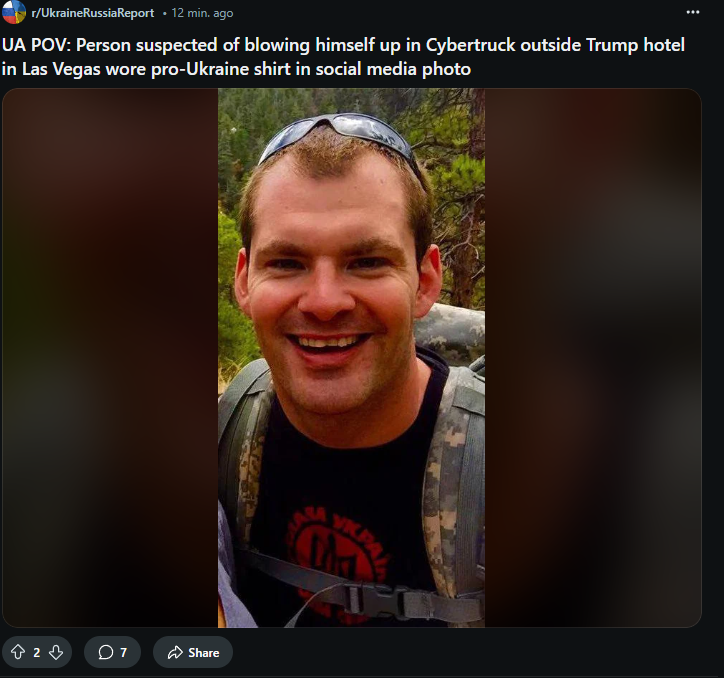
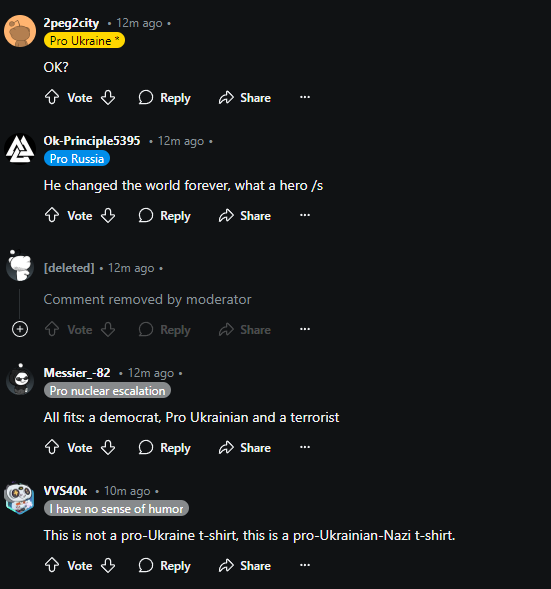
Now take a look at what the same user posted a day before
The topic is completely different however we can see it aligns with Russian disinformation already being pushed onto the public space and the modus operandi is essentially the same at a first glance.
It's cynically trying to establish correlation with the Las Vegas car bomb and Ukrainian armed forces.
At the same time it capitalizes on the moment to push the denazification narratives in the same information sphere.
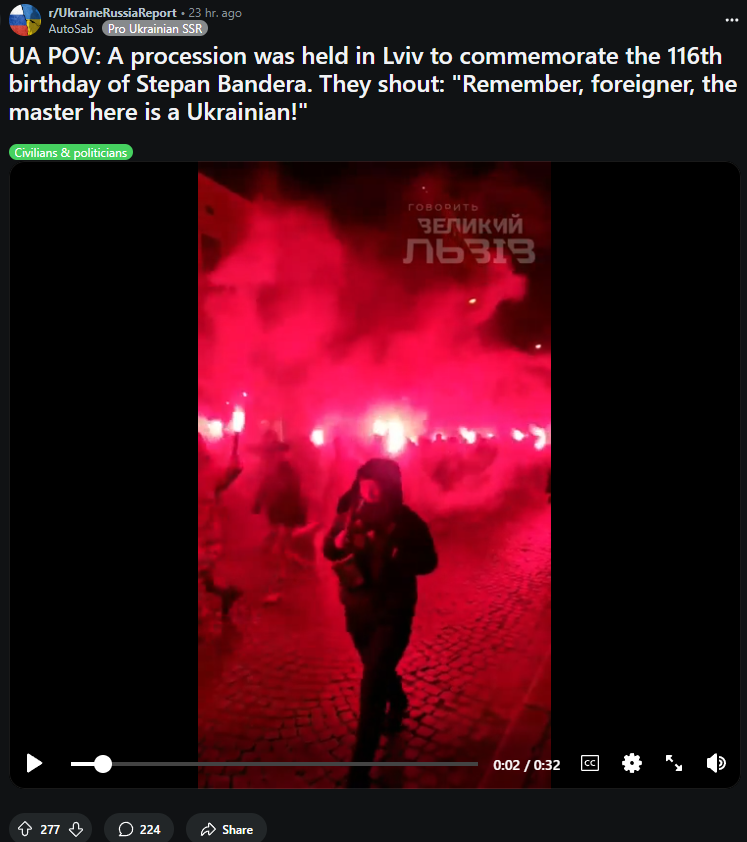
And lets take a look at the first page of comments:
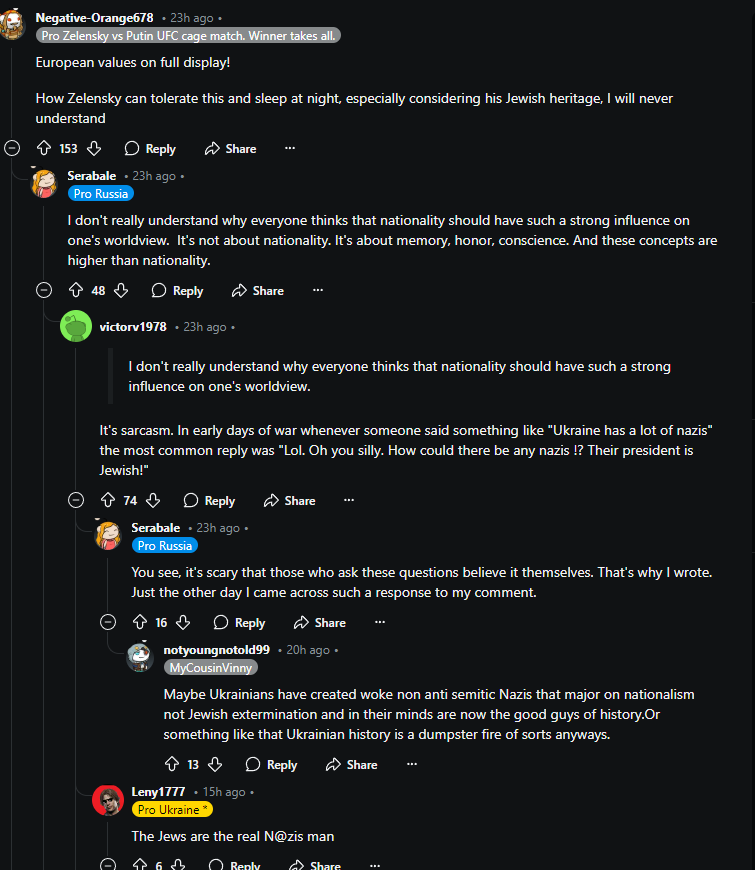
I believe this redditor is a Russian aligned disinformation actor of some kind, there are many examples out there that look and act just like it.
Simply put their objectives are:
Amplify Extremist Narratives: By promoting conspiracy theories related to military actions and government surveillance, disinformation efforts deepens disillusionment and mistrust.
Create Perception of support or condemnation: Disinformation will fabricate or exaggerate the level of support or condemnations for individuals or groups that appeal or are repelled by a certain audience, portraying them as martyrs or heroes... bastards and villains, thereby encouraging or discouraging similar actions from others.
Sow Confusion: By disseminating conflicting reports about the incidents and motives of the people who participate, disinformation actors will create confusion, making it challenging for the public to discern the truth.
It acts as constant stream of pushed and pulled extreme ideologies meant to appeal and also repel people across the whole entire political spectrum in the hopes of pushing people to those extremes, or desensitize them to extremist incoherence.
The point is to generate those responses to adapt further posting to be tailored to indirectly address the most common ones in deceptive ways. It doesn't matter how terrible the events are you will always find a stream of almost predigested propaganda waiting to be deployed and further cause confusion.
Was it the Russians all along??
Well, depending who you are talking to, you might benefit from answering yes or no to this question, however that is not the point of talking about Russia in this post. I hope the person reading this can come up to their own conclusions. My straight answer is no, it wasn't the Russians all along, whatever that means.
I personally do not believe in a global hegemonic conspiracy theory but I wouldn't fault anyone if they did. Conspiracies occur all the time often in plain sight and are inherent to the human experience, we only pay attention to a fraction of those conspiracies for a multitude of reasons.
The reason why this matters is because delving into Russian media from the perspective of a disgruntled democracy enjoyer is rather pleasant. The terrible narratives we hear coming out of Russia are often not part of the Russian information sphere
Russians did not create or breed the type of disinformation I am describing as Russian, I am using this terminology to define it while being deployed as a component of the Russian state's media apparatus.
I cannot pretend to know everything there is to know about Deceptive Imagery Persuasion nor do I know where this type of disinformation orginates from precisely. I am simply seeing patterns and writing about them on a blog. I invite feedback and criticism of any kind, my perspective is not immutable.
The Russian state media and it's methods does not represent all Russians, in fact many Russians choose not to engage with political commentary for a myriad of reasons that have nothing to do with politics, they are simply doing the best they can to live their lives much like you and I.
With that said, let's start by breaking down what exactly the Russian state's media apparatus is because engaging with a vaguely defined concept is not a sensible way to engage with the complexity of this world.
First of all, if you did not already know, media in Russia is heavily influenced by the state to various extents. There are no considerable pushbacks to the directives coming from the state among most media outlets, either because they are directly owned by the state or by oligarchs that have close ties to Vladimir Putin and the Kremlin. While some media companies are privately owned, publishing news or content that does not align with the Kremlin supposedly leads to harsh consequences although the exact nature of those consequences is often vaguely alluded to.
Media outlets must comply with Roskomnadzor (Federal Service for Supervision of Communications) regulations, which can lead to fines or blocking for non-compliance. The most typical methods to enforce censorship is to prosecute any detractor for being a foreign agent. Some examples:
Dozhd TV (TV Rain): Labeled as a foreign agent and forced to shut down its operations in Russia, later resuming abroad. source
Meduza: Declared a foreign agent, which significantly impacted its ability to operate within Russia. source
Novaya Gazeta: Closed down in 2022 due to its independent reporting and critical stance toward the state. source
Means of Control
Direct Ownership
All-Russia State Television and Radio Broadcasting Company (VGTRK) is a holdings corporation entirely owned by the state, it includes the international branch of Russia Today and multiple media outlets around Russia. Along with RT, it is pretty much the central nervous system of Russian state media. source
They have been investigated for engaging in nefarious activities to exert influence on other nations such as offering sponsorship to content creators that promote certain narratives in the United States social media sphere. source
Partial Ownership
Another reason why we do not see Russian news outlets criticize the Kremlin positions is because they are partially owned through different means.
Channel One Russia (Pervyj Kanal) is 51% state-owned. All of the remaining shares are held by private entities, including National Media Group and VTB Bank. They are probably the most popular channel in Russia and put a mix of news and entertainment. source
Gazprom-Media is a subsidiary of Gazprom, in which Vladimir Putin holds a controlling stake. They own a national television channel but also purchased international media outlets like NRJ, TNT, Match TV. source
Other Outlets
While it is technically allowed for Russian media to publish a wide variety of content, the state can always Veto the administrative board or simply block access to private outlets. Russians are allowed to criticize the state, like content creators can do it, they are just not allowed to be popular while doing it within Russia.
The Russian state benefits from allowing people to speak their minds, it only won't allow it to influence policies, if you want to do breadtubing with political flavor in Russia, you will not make any money, you will be miserable, the only way for you to survive is to look elsewhere for monetization.
This means that there is a considerable portion of media influence exerted in Russia that is simply unregulated, they have a very diverse independent media scene that is for the most part unpoliticized. The Russian state still tries to exert control over this scene by "allowing" independent media that is generally supportive of the Russian protectionnist ideal to engage in political topics over Telegram channels.
The topic of military propaganda in support of the Russian occupation of Ukraine for example has been largely pushed around Russian media through independent "milblogs".
The milblog scene however, is literally a warzone, most of them were contract soldiers that idolize completely unhinged intellectuals such as Alexander Dughin, they also tend to get assasinated, or their family members, in mysterious circumstances, so it is difficult to really track down their exact influence. They are a little bit like the MAGA analog of Russia, often perceived as oppressed by the state for beign too extreme, once again to the benefit of the Russian state apparatus, giving the impression of impartiality while it is simply the state maintaining its monopoly on violence.
Thank you for making it this far into my post, I hope it provided some insights and I would appreciate any kind of feedback!